

The Chassis
Aussie Invader Looked to Nature
The Chassis for Aussie Invader 5R is unique, a typical Australian approach to a complex problem. How do you build a 52′ long (16m) long rocket car with all the following prerequisites?
- Maximum safety
- Minimum chassis flex
- Simple in construction
- Extremely strong
- Easy to construct and work on
The answer is simple, use a 40 ft (12m) long high grade steel pipe with a 36 inch (914mm) outside diameter. This pipe is 10mm thick and was rolled from a flat sheet and seam welded. The pipe actually weighs a massive 2.5 tonnes and this weight also serves another purpose and it is not what you might think (covered later in this section).
Sometimes man does not always have the answers to complex problems and looking to nature can often supply the answer. Some of the toughest and strongest creatures on the planet are insects and Aussie Invader 5R has borrowed its construction from their example, having it’s skeleton (chassis/mainframe) on the outside, unlike most race cars that have theirs on the inside, covered with a thin protective skin.
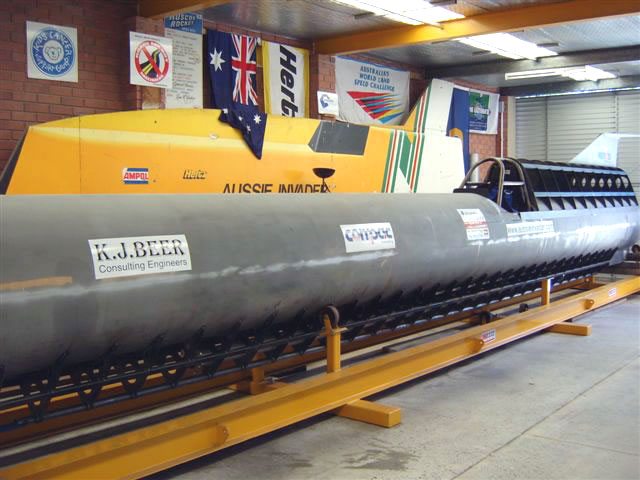
This reversal gives Aussie Invader 5R a very strong and rigid structure that protects all the rocket pressure vessels, fuel and oxidiser tanks as well as the driver.
This design also keeps the weight up and that helps slow the car’s acceleration down. It may seem strange to try and build the fastest car in the world and then intentionally try and slow it down, but that is what we have done.
The 40′ mainframe weighs in at 2.5 tonnes and with all the other equipment, tanks and ancillaries, the car actually weighs 6.2 tonnes, without propellant. This weight will help slow the acceleration down, as we need to limit the car to a maximum acceleration of 3.2 G’s. If we exceed this, the 140kg alloy wheels will not be able to spin up quickly enough and they will lose traction, meaning all four wheels could spin at different speeds and act as gyros, wanting to pull the car in different directions, making handling almost impossible.
How the chassis / mainframe looks fully fitted

A “V” shaped underbelly runs the length of the car; this is to deflect the ground generated shock waves when the car goes supersonic. The “top hat” section runs aft of the drivers seating position which is towards the rear of the car. This is an ideal seating position, as it allows the driver to feel what the back of the car is doing and see front clearly.
The “top hat” also houses the pumps batteries, electrics and regulators for the cars hydraulics as well as the air brake mechanics, doors, on-board computers and the two parachutes (high and low speed). This structure is also used to add support and position the vertical and horizontal stabilisers.
A series of bulkheads along the length of the mainframe separating pressure vessels, oxidiser and fuel tanks from the driver and adds further stiffness and strength. A 1.5″ x .083″ rollcage made from 4130 steel is welded to the forward and aft driver bulkheads. These not only protect the driver in the event of an accident but aids in stiffening the “cut-out” for the driver’s cockpit. A detachable composite nose, bolts to the front of our mainframe and houses more on-board data monitoring equipment.
Rosco and the Aussie Invader team believe that this unique and cleverly designed car will help Australia break the World Land Speed Record and move on to 1,000 mph. Our thanks go to the sponsors of the chassis, Orrcon Steel and Oilfield Traders.