The Car - Aussie Invader 5R


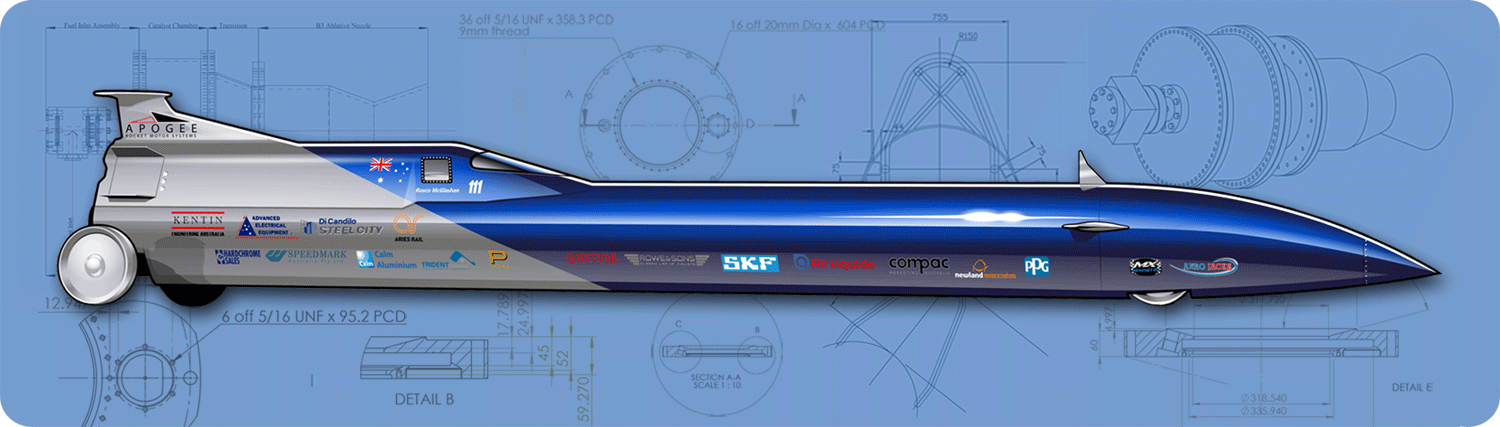
Rosco McGlashan OAM is a “man on a mission” and not content with holding the Australian Land Speed Record, he is going after the ultimate goal of the World Land Speed Record. Rosco, with his dedication and proven ability, has enlisted a skilled team to build a car capable of breaking the sound barrier and moving on to 1,000 mph.

The car is Aussie Invader 5R and will run a single rocket engine, producing around 62,000 lbs of thrust (about 200,000 horsepower). The car weighs about 9 tonnes fully fuelled and will be capable of accelerating from 0 – 1,000 mph (1,609 km/h) in 20 seconds. In that time the car will burn close to 3 tonnes of propellant!

View a video introducing Rosco and the Aussie Invader Land Speed Record challenge.  

The work in building Aussie Invader 5R is now in full swing, with preliminary planning and design work having taken a decade before the build could start. The science and technology behind such a project is staggering and only now is some of that coming into the reach of people like us, a dedicated and committed small team, driven with a passion to achieve the seemingly impossible.

Rosco McGlashan OAM leads the team, and is also the driver of Aussie Invader 5R. Rosco has 45 years in the Land Speed Record environment, chasing records and becoming the Fastest Aussie on the planet, having driven Aussie Invader III to a one way pass of 643 mph (1,035 km/h)!

An Overview of How it All Works

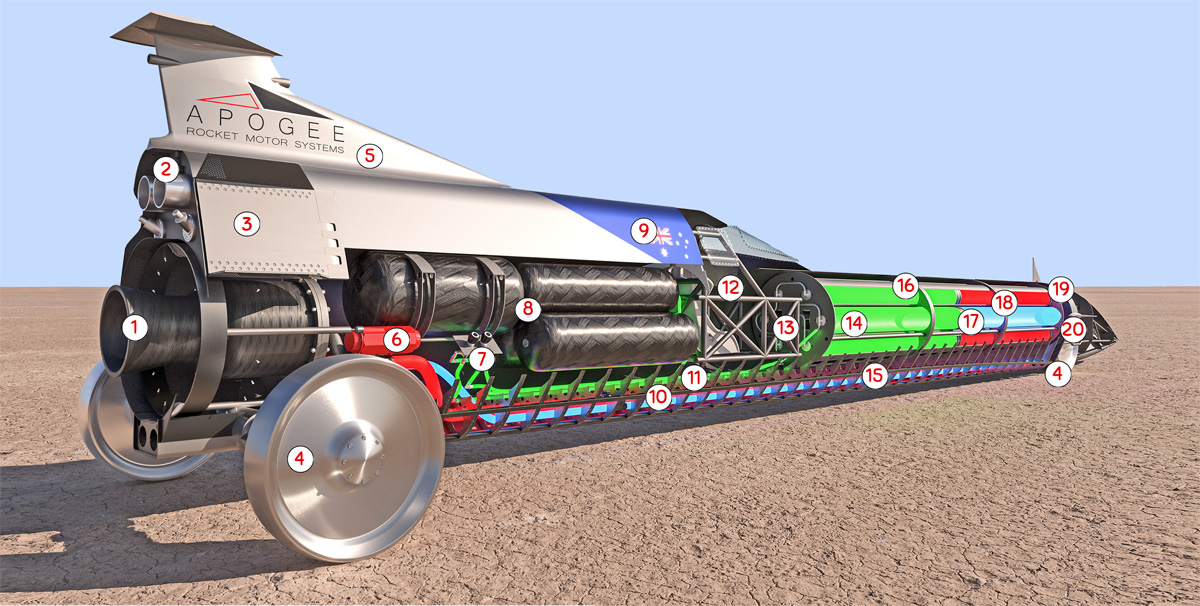
The computer aided drawing below, shows Australia’s best kept secret. It illustrates the simplicity of the concept. What makes Aussie Invader 5R a serious contender for the World Land Speed Record, is its method of propulsion. There are virtually no internal moving parts.
 
The car is using a single throttleable LOX (liquid oxygen / bio-kerosene) rocket motor producing around 62,000 pounds of thrust. The propellant (fuel and oxidiser) is blown down into the combustion chamber with pressurised helium and not with mechanical pumps as most conventional rockets. The total thrust of 62,000 pounds equates to around 200,000 hp on estimated speeds and acceleration.

Click on image for larger cutaway version

Starting from the front the first tank holds the liquid oxygen (oxidiser). Behind this tank is a tank of helium, which will pressurise the oxidiser and force it into the rocket motor. Behind the steel bulkhead, is the cockpit and behind that a large tank containing the bio-kerosene. From there we have a second tank of helium, used to pressurise the fuel into the rocket motor.

Once the fuel and oxidiser are released, they run through regulators to keep the flow measurable into the combustion chamber, where they mix and are ignited. Once lit Aussie Invader 5R will accelerate from 0 to 1,000 mph (1,609 km/h) in an estimated 20 seconds.

Trajectory simulations carried out by engine development scientists at Rocket Lab in New Zealand, suggest that our cars dry weight should be a minimum of 14,000 lbs (6,363 kgs).
This weight will maximise the thrust potential required to accelerate AI5R to 95% velocity in those 20 seconds. At this point AI5R should enter the measured mile. Upon breaking the first timing beam in the measured mile the engine will be throttled back to about 75% power and drag should equal thrust, meaning AI5R will no longer accelerate and hopefully maintain a constant speed through the measured mile.

Our wheel rating at maximum velocity is a major concern; we do not want to exceed their safety rating and must limit their maximum wheel speed to 10,000 rpm. At these speeds there is massive G-force on the wheel rim and wheels are currently being designed to withstand these forces.

The car should exit the mile in well under four seconds and then the fun begins. We have to shut the motor down in stages, otherwise the car and driver will experience a negative G of such high proportions, that the driver would black out and it would send the wheels into a frenzy searching for traction. For safety, the motor will be reduced to half throttle to maintain driver control and traction and then reduced further as the car slows, allowing parachutes and brakes to assist the stopping process.

Throttling down our motor in stages adds extra distance to bring this “missile” to a standstill. It then has to be turned around, towed back to the staging point for the mandatory return run. We then need to refuel, re-oxidise, recharge our helium tanks, re-chute and do a total check over before doing it all again within one hour. The combined average speed in both directions hopefully establishes a new World Land Speed Record… simple really!

The Past Design Studies of Aussie Invader 5R

A decade of design has seen different body styles and propulsion systems tested. The images below are some of the designs and studies we undertook to get things right. We now believe we have the best design to attempt the World Land Speed Record and move on to 1,000 mph.